About Myalgic Encephalomyelitis (ME)

Monday, 25 June 2018

TDs & Senator at M.E. Visibility Protest, 10th May 2018

There was great interest and some promises made by a few Government Reps, who attended the 2018 Millions Missing Visibility Event on May 10th outside Leinster House, Kildare Street, Dublin, to help further the cause of ME patients in Ireland. 

1. Roisin Shortall TD Soc Dems with Noreen Murphy (MEAI)
 in front of the M.E. patients' Info Tag display

Those who came out and talked with us: 

Gino Kenny -PBP
Roisin Shortall -Soc Dems
Catherine Murphy -Soc Dems
John Lahart -FF
Robert Troy -FF
Michael Harty - Ind
Seán Barrett -FG
Thomas Pringle -Ind
Joan Collins - Ind
AnneMarie Mc Nally -Soc Dems
Michelle Mulherin Senator (former FG TD)
Eamon Scanlon - FF
Peter Burke -FG
Billy Kelliher -FF
Richard Boyd Barrett -PBP

Eamonn Scanlon TD (FF), Thomas Pringle TD (Ind) and Senator Michelle Mulherin were very supportive attending the event. They listened to ME Advocates Ireland (MEAI) members and attendees talk about M.E. issues and the deliberate neglect of M.E. patients by the HSE. All want to stay in touch. Senator Mulherrin said she will do her best to raise M.E. with the Oireachtas Health Committee.

John Lahart TD (FF) who also attended the event and showed support chatting to M.E. patients, their carers and families, has recently written to say that he has placed a number of Parliamentary Questions on the issue of M.E., and has written directly to the chair of the Oireachtas Health Committee, Michael Harty TD (Ind), requesting a meeting of the committee with ME Advocates Ireland (MEAI). As soon as he has a response he will be back in touch. 
He showed a lot of interest in Severe M.E. patient Noreen Murphy (MEAI) and had a lengthy chat with her and some of her extended family who were present.

Gino Kenny TD (PBP)  who attended the Millions Missing Visibility event gave much of his time talking to many attendees. He also talked to Noreen Murphy (MEAI member, Severe M.E. patient and advocate) at her car outside Leinster House where she had to lie down after she deteriorated from sitting upright in her mobility chair and from the effort of taking part in the event. He remembered her speech about her Severe M.E. that was read out by M.E. patient-advocate Moira Dillon (MEAI) in the AV Room in Leinster House in January, and he was very happy to meet her face to face. He said that he was doing all that he could to help M.E. patients. Many thanks to Gino for your continual support and efforts made in Dail Eireann on behalf of M.E. patients. 

Noreen was full of praise for her local TDs Peter Burke (FG) and Robert Troy (FF) who she said offered support and a listening ear during the protest. First out to Noreen was Robert Troy who tried to do what he could do in the Dail to get some assurance from Health Minister Simon Harris while the protest was taking place outside. He came back out to say he hadn't got anywhere but we are grateful to him for making the effort.

Many many thanks to the unwavering support of Roisin Shortall TD, Catherine Murphy TD, Annemarie Mc Nally TD and Michael Caul (MyNameis Campaign), all members of the Social Democrats Party, who attended the Visibility Protest and listened to patient-advocates talk about the M.E. issues in Ireland that need to be urgently resolved. We are grateful to them all for attending and also for providing attendees with use of the facilities at the Social Democrats office nearby.

Other TDs e.g. Richard Boyd Barrett (PBP), who were busy with party photo-calls for the upcoming Repeal Referendum, made it their business to say hello and listen to some attendees. 

Overall there was a reasonably good attendance by Government Reps at the Visibility Protest. 
Those who responded to email invitations from the hosts, ME Advocates Ireland (MEAI), and many M.E. patient-constituents to come out to meet attendees, showed good interest and hung around chatting and gave of their time. 
Attendance at the Visibility Protest may have been better if Government Representatives had not been so busy with both Repeal Referendum and the Cervical Check Scandal, etc in Leinster House on the day.


2. Noreen Murphy (MEAI)  & family with John Lahart TD FF
putting on blue ribbons provided by Noreen's grandsons for M.E. Awareness

3. Joan Byrne (MEAI) chatting with Joan Collins  TD Independent 
4. Gino Kenny PBP TD with Camilla Cruise (MEAI) and her dad 
5. Michelle Mulherin Senator with Noreen Murphy (MEAI)
6. Seán Barrett TD FG with Marian Flynn, Camilla Cruise (MEAI)
& Gino Kenny TD PBP
7. Joan Byrne (MEAI)  with Roisin Shortall TD Soc Dems 
8. Thomas Pringle TD Independent with Christine Fenton (MEAI)
  • More images of the event can be viewed HERE 
9. Alan Robertson (right) and other visibility event supporter (left)
with Richard Boyd Barrett TD PBP in background
11. Christine Fenton (MEAI), Joan Byrne (MEAI) with Joan Collins TD 

We urge all TD's to take a note of the UK Members of Parliament debate on Myalgic Encephalomyelitis (M.E.): Treatment and Research in Westminster Hall, London, on Thursday June 21st,  2018

There is an urgent need for the Irish Government and HSE to:

  • 1) commit to a date to have similar talks about the situation of ME patients. 
  • 2)  to agree a way forward with no further delay
  • 3) ‘change the conversation’ about ME in Ireland


12. Joan Byrne (MEAI), Michael Harty TD Ind and chair
of the Oireachtas Health Committee, & Moira Dillon (MEAI) Gino Kenny TD PBP
in background talking to Noreen Murphy (MEAI)
 as she rests at her car having deteriorated.


Friday, 18 May 2018

From us to you, thank you for being at the ME Visibility Event May 2018


Thursday's ME Visibility Event May 10th happened and the much planned for event outside Leinster House was a great success. 


Those of us who could be there on the day, were there. And even some who really shouldn’t have pushed themselves to be there, did so. And they did so because they have passion and compassion for their fellow patients, belief in the fact that this illness can be helped enormously if only healthcare professionals took the time to get educated about it and because they truly care about patients with ME here in Ireland.

It wasn’t easy organising everything especially when there were days when some of us were just too ill to be even online. There were posters to be organized, tags to be made, frames to be built, press to be contacted, TDs to be contacted, promotions to be followed up, printing to be arranged, T-shirt’s to be ordered, nails to be done, lifts to be arranged, much begging of friends and family to help on the day, etc etc etc. The list goes on. 


But we did it and we did it with you. 

If you sent us your tag, you were there. 

If you sent us your info for a tag, you were there. 

If you turned up you were clearly there! 


For all those who couldn’t make it because they were too ill, we held the space for you. We were honoured and pleased to do it. Your story and your pictures were read by many, many people - TDs, fellow patients, friends, public and even the policemen outside Dáil Éireann. They saw you. They know you exist.

And now the follow up begins. As part of that follow up we may be asking you to recontact some of your TDs and we hope you will do that. We may be asking those who didn’t manage to get their info to us, to send it now so that we can build up a reservoir of patient numbers for any future events. 

For now we are resting. We will process all that happened, follow up with all those who committed their support and continue our ongoing work with the HSE to ensure proper medical training of healthcare professionals for patients with Myalgic Encephalomyelitis in Ireland.

From us to you, thank you for being there...


  • Article in the Journal.ie here


M.E. Advocates Ireland founding members
Standing: Moira Dillon, Joan Byrne,
Seated: Camilla Cruise, Noreen Murphy, Christine Fenton.
Missing are Rachel Lynch & Corina Duyn


A snapshot of the M.E. Visibility Protest in Dublin 2018


A few of the images of the M.E. Visibility Protest which was held outside Leinster House on the 10th May 2018.

Read a brief account of it HERE.


And please scroll through the other posts on this ME Advocates Blog 

to read more about the event,  podcasts, news paper arrticles, the fight for recognition, 

personal stories and the way we think change should happen.


See more images on our Instagram Page 

Wednesday, 9 May 2018

Podcasts of Interviews by Members of ME Advocates Ireland (MEAI)


This page includes podcasts of interviews by members of 
ME Advocates Ireland (MEAI) 


Corina talks about the article about living with ME during Covid-19 restrictions as well as the two year fight with the HSE to gain proper care and PA support.


In this second interview from her bed Noreen Murphy chats with Ray Dolan to highlight M.E. in an effort to get recognition, support, care and treatment from our government, HSE and Health Minister and, of course, to get our GPs taught about M.E.  


Christine Fenton was invited to talk about ME by a local radio station in Castlebar, Co Mayo. Christine chatted on CRCfm with Angela Faull on Thursday  Jan 10th, 2019 about ME in general and about her own illness. 


A very clear interview about what M.E. is, how it affects people, especially those severely affected. Including paralyses.  And details about the ME Awareness Protest in Dublin 10th May, and why we are out there.


Interview from her bed- with Ray Dolan to highlight M.E. #MillionsMissing demonstration outside Leinster House Thursday, 10th May, from 11:30 until 2:30 in an effort to get recognition, support, care and treatment from our government, HSE and Health Minister and, of course, to get our GPs taught about M.E.


"On the show Presenters Bernadette Phillips and Stan Phillips spoke with Author Corina Duyn about the 'reality' of living with M.E. and the aftermath of travel. Also about the upcoming M.E. #MillionsMissing Event in Dublin hosted by M.E. Advocates Ireland happening on 10th May which is part of a global campaign for M.E. health and Equality." Also  8th March 2018  & November 2017 reality of M.E. and society's views on disability.


"I suddenly started losing the use of my legs, my arms...and my body stopped functioning."
Myalgic Encephalomyelitis (M.E.) patients - who experience severe, persistent debilitating illness, held a peaceful awareness protest outside Leinster House today to highlight what they claim is the utter neglect of ME patients in this country.


  • A Mullingar woman with severe ME has set up an online petition for the drug, Ampligen, to be licenced and made available to treat people with Myalgic Encephalomyelitis (ME). Noreen Murphy says the treatment is available in the US but not in Ireland. Noreen has been telling Keith Shanley on the Midlands Today Show that she has written numerous letters to the Department of Health.


The situation of Myalgic Encephalomyelitis Patients in Ireland - A Summary


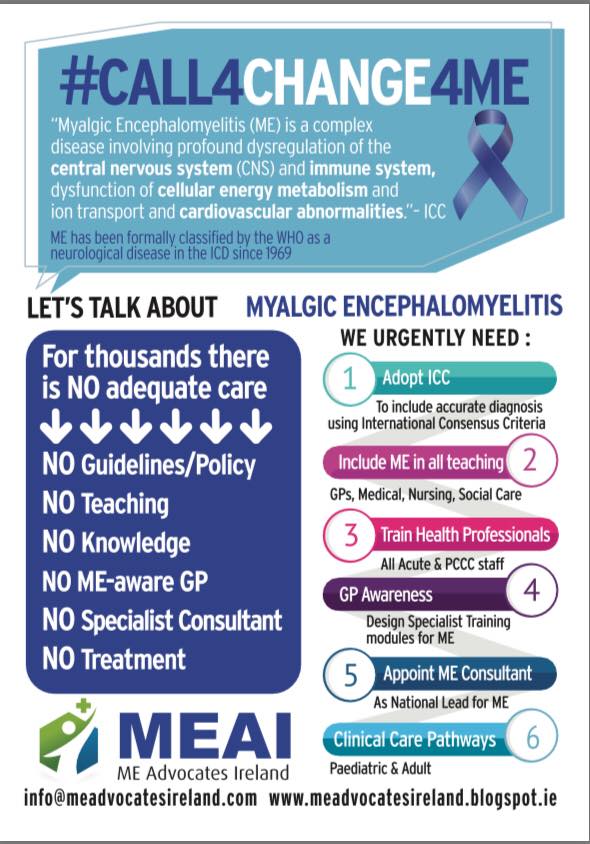
 Let's Talk about 

Myalgic Encephalomyelitis

(ME)


1 National M.E. Policy- adopt ICC
2. Appoint a consultant
3. Train Health Professionals
4. Include M.E. in all training of GP's Nurses and Social Care
5. Create clear Clinical Pathways


The situation of Myalgic Encephalomyelitis Patients in Ireland
Summary

  •        ME  is an acquired, complex, neurological disorder affecting multiple body systems. It is classified by the WHO in their International Classification of Diseases as Neurological (under code G.93.3) since 1969

  •   Despite what the public are led to believe, it is not difficult to diagnose. The International Consensus Criteria 2011 is a comprehensive diagnostic tool for medical professionals and was developed by world experts with a combined total of 400 years treating over 50,000 patients with ME throughout the world

  •        Common symptoms include headaches, bone and muscle pain, swollen lymph nodes, muscle weakness, muscle spasms, seizures, neck pain, vision abnormalities, cognitive impairment, photo sensitivity, noise sensitivity, paraesthesia, bladder and bowel dysfunction, digestive dysfunction, sleep dysfunction, cardiovascular abnormalities, etc

  •      The body’s ability to generate and produce energy at a cellular level is seriously impaired, meaning systems and organs cannot function properly, causing progressive systemic deterioration

  •        Post Exertional Neuroimmune Exhaustion (PENE) is the cardinal system of ME Essentially this means that any action – physical, cognitive, emotional, social – which demands energy from the body will impact on the patient’s condition, causing a marked worsening of all symptoms which can last for days, weeks or months – sometimes even causing a permanent, non-recoverable relapse.

  •      Many people with ME are dependent on carers to meet their basic needs for food and personal care

  •      ME is a spectrum disease and those at the very severe end cannot eat or swallow, cannot toilet themselves, cannot speak, are paralysed and living in excruciating pain with a myriad of complex systems

  •       People with ME have compromised immune systems, leaving them open to opportunistic infections and other pathogens. There is a high rate of cancer amongst patients.

  •       Deaths among the ME population are rarely attributed to their ME but more usually attributed to secondary causes such as cancers, cardiac issues and, in many cases, suicide. Many ME patients throughout the world have taken their own lives because they simply cannot live with the neglect of this condition and the lack of hope on the horizon

  •        Life expectancy is shortened as systemic deterioration becomes cumulative

  •       There are an estimated 9,000 to 18,000 people living with Myalgic Encephalomyelitis in Ireland. These figures are based on extrapolating from data in other countries. There is no collation of data on numbers with the condition here in Ireland

  •        People with ME in Ireland are often left to rot in darkened bedrooms because their doctors do not understand or ‘believe’ in ME.  

  •        There are NO ME specialist hospital consultants within the HSE


  •        The HSE have failed to put in place clear diagnostic criteria and appropriate careplan pathways for people with ME in Ireland

  •        The Royal Academy of Medicine in Ireland concluded in a published paper on ME in September 2010 “There is a need for further education of the medical profession on this debilitating condition and there is clearly a need for further research into treatment which directly impacts upon the quality of sufferers”. Eight years later, this is still the case. Nothing has changed.


  •        Children as young as four years of age have been diagnosed with ME There are older young people ‘stuck’ in the Irish paediatric hospital system because there are no appropriate adult hospital services to refer them on to.